

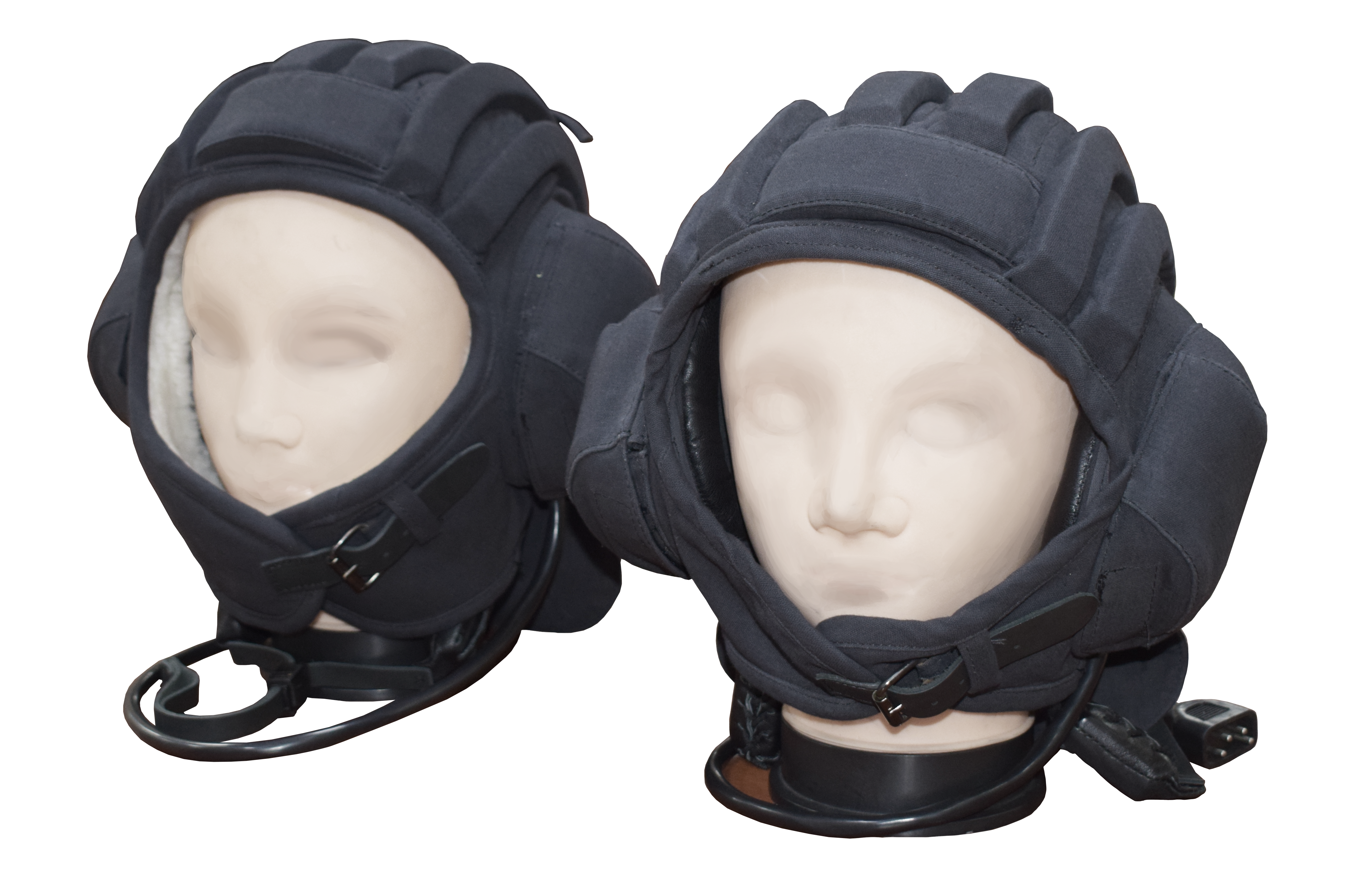
Headsets are made of two types - winter and summer (type W - on a fur lining and type S - on a satin lining) and three conventional sizes (height I, II, III). The growth number of the headset corresponds to the size of a human head: I - head size up to 56 cm, II - 57 - 59 cm, III - 60 - 61 cm.
The headset is a headdress that covers the entire surface of the head, except for the face.
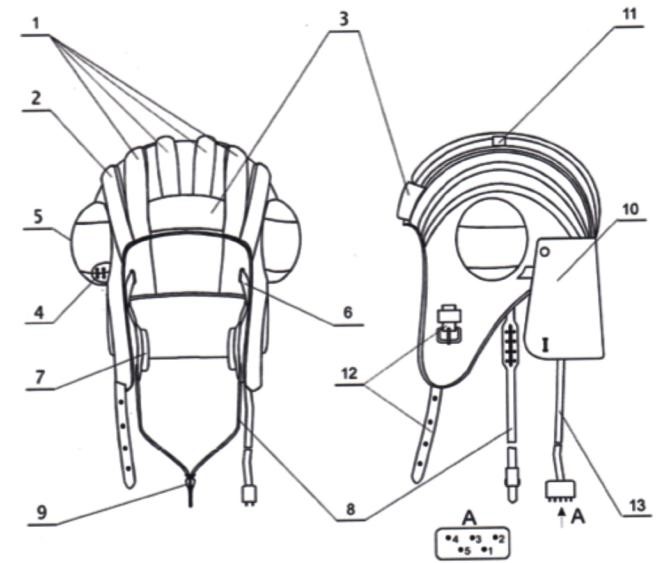
To protect the operator's head from impacts on the structural elements of the object, four shock absorbers (1) are provided, located from the visor to the bottom of the back of the helmet, two temporal shock absorbers (2) located on the sides of the headset each and the frontal shock absorber - visor (3).
Headsets of two types - winter and summer (type W - on a fur lining and type S - on a satin lining) and three conventional sizes (height I, II, III). The growth number of the headset corresponds to the size of a human head.
|
Headset Growth Number |
Head size (cm) |
Percentage of sizes when ordering |
|
I |
Up to 56 |
30 |
|
II |
57–59 |
50 |
The plugs on the sides of the headset are placed in pockets (4), which are closed on top with valves (5). Straps for laryngo cords (6) are laid in the back of the helmet. Soft leather covers are attached to straps for laryngo cords to accommodate laryngo phones (7). Covers have lacing and end with leather straps (8) about 200 mm long, which are fastened at the end with machine stitching. Their size adjustment is carried out with a mobile lock (9). The headset has a flap valve (10) outside the back of the head, protecting the operator from precipitation. In the bent and lowered state, the valve is fastened with buttons on the loops.
To fit the helmet on the head on the outside of the parietal part there is an adjustment belt with a buckle (11). There is also a belt with a buckle (12) for fastening the headset on the chin flap on the head. The headset is equipped with a cord ending in a 4 - pin plug (laryngophone LEM-3), can be completed with a cord ending in a 5-pin plug (laryngophone LEM-5) (13) through which the headset is connected to the chest switch. In the back of the headset, this cord is divided into wires that connect telephones and laryngophones.